Continuing Their Legacy: Education as Missions
The Call for Education as Missions
The call for education as missions is far from being a modern fad; rather, it is a call to a proven strategy that has been one of the most effective means for furthering the work of the Church. Throughout the world and across time, formal and informal education are closely associated with the long-term flourishing of the Gospel showing that education in its many forms has proven to be a remarkably effective way to bring transformation to individuals and communities.
Christ’s final instruction to His disciples was to “go and make disciples of all nations, baptizing them in the name of the Father and of the Son and of the Holy Spirit, and teaching them to obey everything I have commanded you” (Matthew 28:19-20). This profound teaching assignment isn’t simply teaching people what Jesus’ commands are. It includes discipling people, training and helping them to be all God intends.
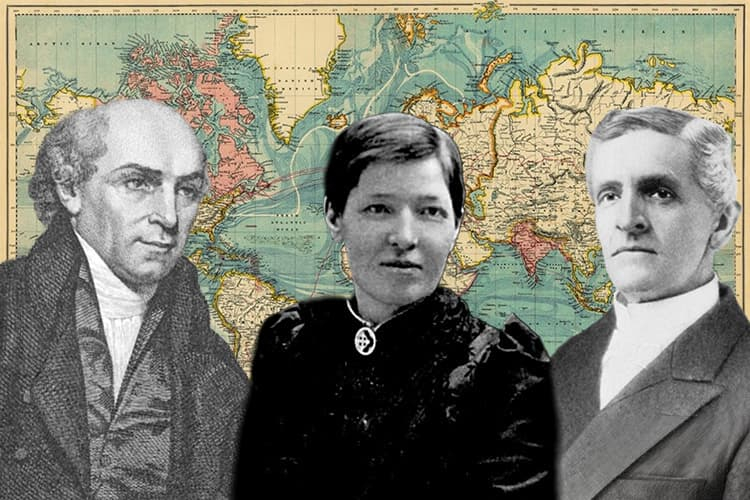
Across centuries when the Church prioritized this discipleship mandate, it prompted personal transformation and cultural renewal. By looking at the legacy of 3 influential missionaries who embraced this missional strategy, we will see how education has been used to reach the nations with the Gospel.
Forebearers, Their Nations, and Their Reach
William Carey and India: Reaching and Dismantling Cultural Norms
In the late 1790s, William Carey arrived in Calcutta (Kolkata), India with a desire to settle, live, and die among the local people. But what drew Carey to India? Growing up during a revolutionary time period marked by industrial progress and world explorations, Carey was particularly inspired by explorer James Cook. This inspiration led him to think about how these world-changing events could advance the Gospel. After spending time teaching and preaching in England, Carey began to have a desire to take the Gospel around the world.
However, as he entered India, he faced a country hostile to the Christian beliefs he brought. Carey also faced immense physical challenges as his family endured chronic dysentery. As Carey endured these trials, he was forced to seek refuge and found it in Serampore. It is during his time in Serampore that Carey’s academic and linguistic ability began to make waves of transformation. Carey and his colleagues began opening schools that taught all the core subjects in the local vernacular language. Their schools were also open to children of any gender, religion, or social standing. This threatened and, over time, weakened the traditional caste system (some of these schools educated future leaders of British India).
By focusing on discipleship rather than quick conversion statistics, God used Carey’s missional strategy of education as missions to begin transforming the intellectual life of India. This commitment to education and discipleship led to the founding of Serampore College in 1818 after Carey and his colleagues had established more than 100 schools.
Mary Slessor and Nigeria: Reaching the Locals
Scottish missionary Mary Slessor is often remembered as Queen of Okoyong in her mission land of Nigeria. Her desire to serve began in her childhood when she had to step up for her family to make money working as a weaver. It deepened when she was older as she learned of missionary David Livingstone’s death in 1873. (David Livingstone was a doctor and explorer who devoted his life to bringing the Gospel to people in Africa for nearly 30 years.)
When Slessor deployed to West Africa at the age of 27 after just 3 years of missionary training, she carried the mission board’s advice: understand firsthand how literacy and practical skills can break the cycle of human poverty and suffering. So, she started learning with and teaching the women in the town of Calabar, and after nearly a decade of this work, she moved to live in Okoyong.
Slessor’s time in Okoyong would last 15 years. She lived in a traditional mud hut, ate native food, traveled barefoot through the jungle, and mastered the local language. This radical identification earned her the deep affection of the locals, which in turn allowed her to pursue her missional strategy of establishing primary schools in remote, unreached villages. The curriculum in these village schoolhouses was designed to teach the whole person. Christian ethics were taught alongside highly practical, locally relevant skills. Slessor’s educational philosophy was built upon the conviction that conversion to Christianity and literacy leading to discipleship went together.
Slessor used her classrooms to train and equip local assistants while she then moved further into the interior to repeat the process. The legacy of her work is embodied in her saying: “After all, it comes back to this: Christ sent me to preach the Gospel, and He will look after the results.” Mary Slessor demonstrated that fulfilling the Great Commission means building grounded, equipped disciples whose service to the Church extends to the community and even the nation.
Henry Appenzeller and Korea: Reaching Through Opened Doors
In the 1880s in Korea, Christians faced severe hostility, leaving no apparent avenue for introducing the Gospel. However, medical and educational infrastructure would change that. As Korean reformers traveled abroad, they discovered Korea needed change to keep up with the competition of a modernizing world. In 1885 King Gojong granted permission for humanitarian services, opening ever so slightly the door for education as missions. Workers came but with strict royal prohibitions against public preaching, church planting, and baptisms. Therefore, evangelism efforts had to be pursued covertly, which made schools an effective framework for establishing the church.
At this same time in the United States, Henry Appenzeller was preparing for ministry as he enrolled in Drew Theological Seminary in New Jersey. It was during his time at Drew that he developed serious interest in foreign missions, and in 1884, he was selected alongside his wife, Ella, to go to Korea to plant a church.
The Appenzellers arrived in Seoul to an educational structure strictly reserved for the traditional Confucian elite. Because classes were taught entirely in the classical Chinese characters, education was made inaccessible to the majority of the Korean population. The Appenzellers, along with their missionary colleagues, established 2 schools: Pai Chai Hakdang, a school for training useful men, and Ewha Hakdang, a school for women. By teaching entirely in Hangul (the language system of the common people), these schools made both education and the Bible accessible in the language of everyday people, allowing Christ’s transforming Gospel to reach the heart of the Korean community in Seoul.
The legacy of the Appenzellers’ missional strategy remains visible in South Korea today. The foundation laid by Pai Chai Hakdang has grown into a network of nearly 400 Christian educational institutions as well as a vibrant Korean Methodist Church. Remarkably, Korea is a nation seeing roughly 30% of people identifying as Christian. Once again, education did not simply act as a passive, secondary tool; it was the tool the Spirit used to establish the Church.
Conclusion: Sinners Serving God
It’s easy for us to read these stories and elevate these missionaries as heroes of the faith. While they accomplished marvelous work for the kingdom of God, each of them also acknowledged the mistakes they made along the way, some small and some big. They would be quick to remind us of the apostle Paul’s words: “Be imitators of me as I am of Christ” (1 Corinthians 11:1).
At TeachBeyond we seek to follow in the footsteps of Carey, Slessor, Appenzeller, and many others in using education as missions. By doing so we will see communities transformed into all God intends and partake in the kingdom work of God. As we look back at these examples of education as missions, may it spur us forward with confidence that God has and will continue to open the doors to reach the nations through education.
Acknowledgement and Resources:
I sincerely thank George Durance whose in-depth research anchored this article. While this article only scratches the surface of his depth of knowledge, his work and generosity provided an invaluable foundation for me to tell these stories and explain the call to education as missions. Additionally, the following resources were used to provide further context:
Pastor Travis Eiles. “The Life and Ministry of William Carey.” YouTube video, King’s Cross Church
Missionary Stories from Around the World by Betty Swinford
https://learn.ligonier.org/articles/missionary-mary-slessor
https://www.ebsco.com/research-starters/womens-studies-and-feminism/mary-slessor
https://www.bu.edu/missiology/missionary-biography/a-c/appenzeller-henry-g-1858-1902/
https://www.umc.org/en/content/appenzeller-henry-g-1858-1902
Related Stories